


Facts
-
Team
Scuderia Ferrari -
Engine
Ferrari V10 -
Capacity
3 litres -
Power
835 bhp at maximum 18,400 rpm -
Chassis
Sandwich construction, carbon fibre-reinforced plastic, aluminium honeycomb structure -
Weight
600 kg -
Designers
Ross Brawn, Rory Byrne, Aldo Costa, Nicolas Tombazis -
Drivers
Michael Schumacher, Rubens Barrichello -
In action
From Brazil 2002 to San Marino 2003 -
Starts and wins
19 races, 15 wins -
Historical significance
Dominant car in 2002 season with 14 wins from 17 GPs. Schumacher’s fifth title, equalling Juan-Manuel Fangio’s record. Winning car in the highly controversial 2002 Austrian Grand Prix. -
Driver in the Red Bull Legends Parade
Rubens Barrichello

The car
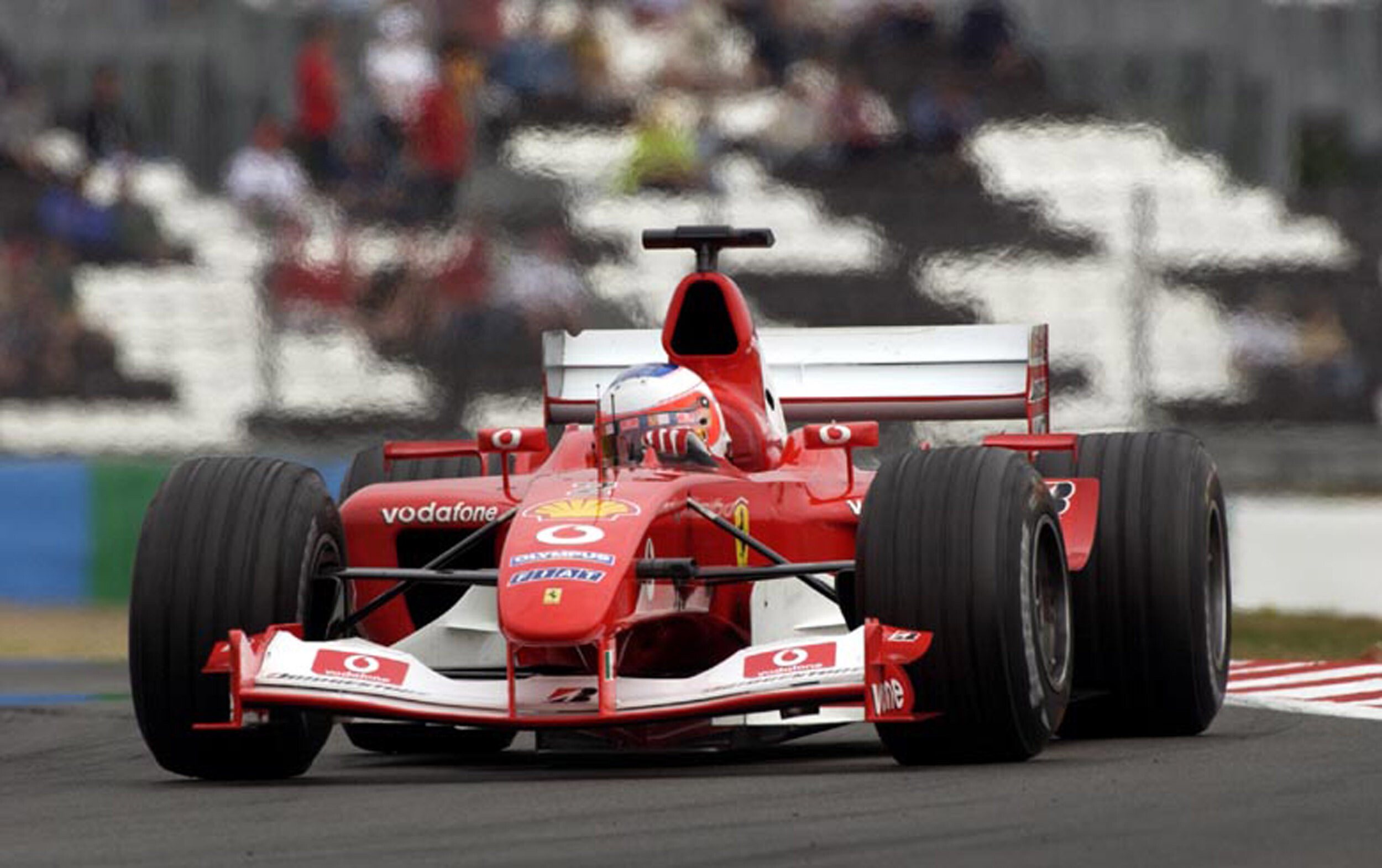
Although Ferrari had produced the world championship-winning car in the two previous years, the F2002 turned out to be yet another major improvement. When compared to the F2001, it had a new, lighter, stronger gearbox made of titanium, which significantly lowered the car’s centre of gravity. A more compact design increased aerodynamic efficiency, while the 051 V10 engine was in a class of its own. The Ferrari drivers took 15 victories from 19 race starts. And what was even more impressive, the two Ferrari aces secured 221 points in the 2002 season, which was as many as the 20 drivers from the remaining ten teams combined. This car was still able to win even at the start of the following season.
The drivers
Rubens Barrichello and Michael Schumacher: Barrichello replaced Eddie Irvine at Ferrari in 2000. Signed as the number two driver, he was obliged to follow team orders, which led to a never-to-be-forgotten moment in the history of the Austrian Grand Prix at Spielberg. Seven-time world champion Michael Schumacher is one of the sport’s all-time greats. The career of the German, who came from what were, by F1 standards, modest circumstances, really took off in Austria. Up until then, he had to watch every penny and sometimes even sleep in a lorry cab at the racetrack. He was spotted by German racing manager Willi Weber during a Formula 3 race at the Salzburgring in August 1988. In pouring rain, Schumacher had taken the corner perfectly ten times in a row, to the nearest centimetre. Weber took care of financing the career that sent the whole of Germany into a Formula 1 frenzy. Schumacher won twice at Spielberg in the last two races at what was then the A1-Ring.
Fascinating facts
Notwithstanding all the fame and glory that this car has achieved, it will always be associated with one of the most controversial moments in motor racing history, with an incident that took place in 2002 at, yes, Spielberg of all places on the former A1-Ring. Michael Schumacher had dominated the start of the season, but Rubens Barrichello was in the lead during the race and heading for victory. However, a clause in his contract said that he must let Schumacher go through before the finish line, and this was happening again, just one year after he had been forced to let him pass on the same track, following Team Principal Jean Todt’s legendary instruction: “Let Michael pass for the championship!” In 2001, it had only been about second place, but it was a matter of victory this time around, which caused millions of fans to be outraged and led to boos from spectators in Austria at only the fourth race of the season. And it turned out to be totally unnecessary, as Schumacher went on to secure the world championship with six races to go.
The story
The F2002 is one of the most successful racing cars of all time. Known as the ‘Red Goddess’, it is a Formula 1 technical icon. The team that built this car featured an all-star line-up with input from many of the world’s greatest engineers at the top of their game. Technical Director Ross Brawn and Chief Designer Rory Byrne, who had already been a well-established team with Michael Schumacher since their Benetton days, now enjoyed the support of the likes of Aldo Costa, Nicolas Tombazis, James Allison, Gilles Simon and Engine Department Head, Paolo Martinelli, all engineers who played a big role in shaping the first quarter of this century with various Formula 1 teams.
Driver in the Red Bull Legends Parade: Rubens Barrichello
Ironically, yesteryear’s tragic hero now has the honour of getting back into the F2002 here in Spielberg, perhaps to collect the well-deserved applause for his racing prowess back then. With 322 grand prix starts and eleven victories to his name, the Brazilian has other reasons to be excited about being with us, since his son Fernando is also here at the Red Bull Ring in the Formula 3 line-up in car number 28.
